
Mon - Fri 8:00AM - 5:00PM Central
1150 SE Hamblen Rd, Lee's Summit, MO 64081
How to Choose a Compliant Cannabis Gummies Container?
Choosing a compliant Cannabis Gummies Container requires more than selecting an attractive jar or pouch. The package must protect the product, communicate essential information, and support responsible use. Requirements can vary by location, so manufacturers should confirm current rules with qualified regulatory professionals. A design that works in one market may fail in another.
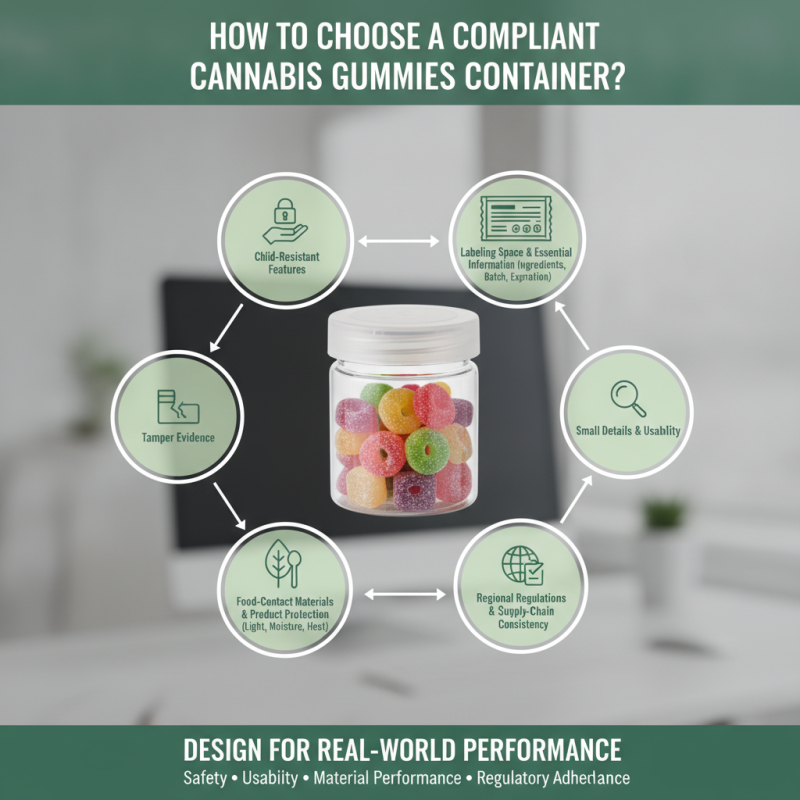
Kim Stuck, a respected cannabis compliance consultant, has offered a practical reminder: “Compliance belongs in the design, not at the end.” That principle matters during every decision, from material selection to final label approval. A suitable container may need child-resistant features, tamper evidence, suitable food-contact materials, and protection from light, moisture, or heat. It should also provide enough surface area for clear warnings, ingredient details, batch information, and expiration dates.
Small details matter.
Picture a gummy container on a retail shelf. The lid closes firmly. The seal shows visible damage when opened. The label remains readable after handling. These details build confidence, but they do not replace documented testing or regional review. Experienced teams can still overlook a closure tolerance, a cramped warning panel, or an adhesive that weakens in humid storage.
This guide examines the practical choices behind a reliable Cannabis Gummies Container. It considers safety, usability, labeling space, material performance, and supply-chain consistency. The goal is not to make packaging look compliant. The goal is to create packaging that performs compliantly in real conditions, where customers open, carry, store, and sometimes mishandle it. That standard is harder. It is also more honest.
Define Compliance Requirements for Cannabis Gummies Containers
Before selecting a container, define the exact compliance duties for your target market. Requirements may cover child resistance, tamper evidence, opacity, labeling, and material safety. In the United States, 16 CFR 1700.20 describes child-resistant packaging test procedures. ISO 8317 also provides a recognized test method for reclosable packages. These standards are not interchangeable everywhere. Confirm the current rules with a qualified regulatory specialist. Do not rely on a supplier’s general claim.
Safety data shows why these details matter. The 2021 National Poison Data System recorded 7,043 cannabis exposure cases among children aged zero to five, according to research published in JAMA Pediatrics. A compliant gummies container should resist opening by young children, yet remain usable for adults. It should also prevent accidental access after opening. Choose an opaque structure when light protection is required. Leave enough space for dosage, ingredients, allergens, batch identification, expiry information, and mandatory warnings. The container should not encourage consumption through playful shapes or child-attractive graphics.
Test the complete package, not only the lid. Gummies can leave oil around threads, weaken seals, or create sticky surfaces. These small issues may affect reopening performance. Tamper evidence should be visible before purchase. Material declarations and migration testing should support product-contact safety. Recyclability claims need evidence, too. One weak assumption remains common: passing a child-resistant test does not guarantee real-world safety. Humidity, repeated use, and damaged closures can change performance. Document every test, artwork version, supplier certificate, and production check. That record supports traceability when a requirement changes.
How to Choose a Compliant Cannabis Gummies Container? - Define Compliance Requirements for Cannabis Gummies Containers
| Compliance Dimension | Recommended Container Requirement | Typical Verification Method | Why It Matters |
|---|---|---|---|
| Child Resistance | Use a container and closure system certified or tested to the child-resistant packaging standard required in the target jurisdiction. | Obtain an accredited laboratory report and retain supplier compliance documentation. | Cannabis edibles must be designed to reduce the risk of accidental access by children. |
| Opaque or Light-Blocking Design | Select an opaque container or packaging format where local rules restrict cannabis products from being visible through the package. | Perform a visual inspection under normal retail lighting and compare the design with applicable regulations. | Opaque packaging can limit product visibility and help prevent packaging from appealing to minors. |
| Tamper Evidence | Include a tamper-evident seal, band, shrink sleeve, or equivalent feature when required by the applicable market. | Document seal integrity testing, opening evidence, and package-line inspection procedures. | Tamper evidence helps indicate whether the package may have been opened or altered after filling. |
| Food-Contact Safety | Use materials suitable for direct contact with food and compatible with gummy ingredients, oils, acids, and colorants. | Review food-contact declarations, material specifications, migration information, and supplier certificates. | The container must not introduce harmful substances, odors, flavors, or contaminants into the gummies. |
| Material Compatibility | Choose a material that resists moisture, grease, sticking, and chemical interaction during the intended shelf life. | Conduct accelerated and real-time compatibility or stability testing with the finished product. | Poor compatibility can cause leaking, deformation, odor transfer, gummy adhesion, or potency changes. |
| Package Integrity | Use a rigid, properly sealed container that protects the gummies from crushing, contamination, and accidental opening. | Perform leak, drop, compression, closure-torque, and seal-strength tests appropriate to the package format. | A reliable package preserves product quality throughout filling, transportation, storage, and retail handling. |
| Single-Serving or Multi-Serving Format | Select a format that supports accurate serving identification and complies with local limits for package and serving quantities. | Confirm net quantity, serving count, and cannabinoid concentration against the approved product specification. | Clear portion control supports accurate labeling and reduces the risk of unintended overconsumption. |
| Label Application Surface | Provide a smooth, clean, and sufficiently large surface for mandatory information and regulatory symbols. | Create a packaging proof and verify readability, contrast, adhesion, and available label area before production. | A compliant container must allow required information to remain visible and legible during normal use. |
| Label Durability | Use labels, inks, and adhesives that withstand handling, moisture, refrigeration, and expected storage conditions. | Conduct rub, moisture, temperature, and adhesion tests on the completed package. | Mandatory warnings, potency information, batch details, and expiry information must remain readable. |
| Plain and Non-Appealing Presentation | Avoid cartoon characters, candy-like imagery, misleading claims, neon presentation, or design elements that may appeal to children. | Complete a regulatory artwork review and compare all graphics and text with the rules of the sales jurisdiction. | Many cannabis markets restrict packaging that resembles ordinary confectionery or targets minors. |
| Child-Attractive Shape and Function | Avoid containers shaped like toys, animals, common food items, or other objects that may attract children. | Review the physical shape, opening method, color scheme, and overall presentation during design approval. | Packaging form can be regulated independently from the product label and material. |
| Recyclability and Material Identification | Use clearly identified materials and design the package according to local recycling, waste, and environmental requirements. | Review resin identification, component separation, recycled-content rules, and applicable extended producer responsibility obligations. | Environmental obligations may apply to the container, closure, label, and secondary packaging separately. |
| Traceability Support | Reserve space for batch or lot information, production dates, expiry dates, and required tracking codes. | Verify that variable data can be printed, scanned, and retained through the distribution process. | Traceability supports recalls, inventory control, complaint investigations, and regulatory inspections. |
| Storage and Transport Conditions | Specify temperature, humidity, light, stacking, and transport conditions that the container can withstand. | Use distribution simulation and shelf-life testing based on the intended logistics route. | Gummies may soften, stick, bloom, or lose quality when exposed to heat, moisture, or pressure. |
| Regulatory Market Coverage | Confirm requirements separately for every state, province, country, or municipality where the product will be sold. | Maintain a jurisdiction-specific compliance checklist reviewed by qualified regulatory personnel. | Cannabis packaging rules are not uniform and may differ in child resistance, labeling, warnings, recycling, and design restrictions. |
Compliance note: Packaging requirements vary by jurisdiction and product category. Before production, verify the final container, closure, label, artwork, materials, and testing records against the current regulations in each intended market.