CONTACT PHONE 816-380-4747
OPEN HOURS

Mon - Fri 8:00AM - 5:00PM Central

ADDRESS

1150 SE Hamblen Rd, Lee's Summit, MO 64081

How to Choose the Best Smart Circuit Breaker?

Choosing the best Smart Circuit Breaker requires more than comparing prices or mobile app screenshots. A reliable choice should match the building’s wiring, electrical load, and daily operating habits. It should also provide clear protection against overloads, short circuits, and abnormal current conditions.

During practical evaluation, examine the breaker’s rated current, pole configuration, interrupting capacity, and installation method. A compact DIN-rail model may fit a home distribution board, while a larger system may need stronger communication and monitoring options. Check whether the breaker supports Wi-Fi, Zigbee, Bluetooth, or another protocol. Local control can remain valuable when the internet fails. It is easy to overlook this detail.

Safety certification and manufacturer documentation deserve close attention. Look for test reports, wiring diagrams, temperature limits, and clear replacement guidance. A reputable supplier should explain how the device responds after a trip. Remote switching is useful, but it should never replace proper circuit design or professional inspection. No device is perfect.

The right Smart Circuit Breaker should also make energy information understandable. Accurate current readings can reveal a heater drawing excessive power or a circuit operating near its limit. However, app data may contain delays or measurement errors. Compare the specifications with independent reviews and, where necessary, verify readings with professional equipment. Installation should follow local electrical requirements and be completed by a qualified electrician. This guide will help compare essential features, practical limitations, and long-term reliability before making a confident decision.
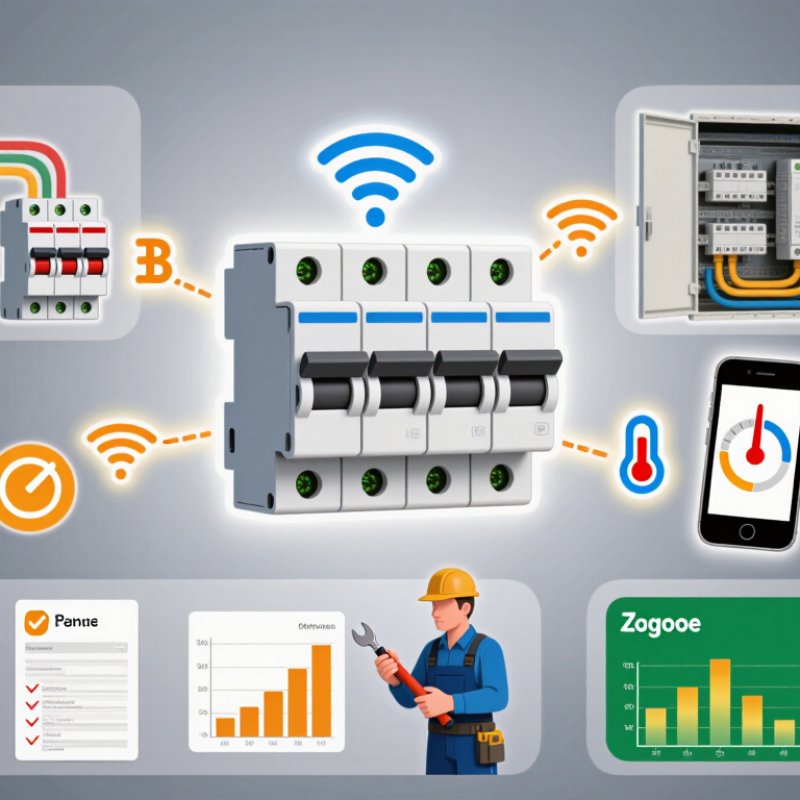
How to Choose the Best Smart Circuit Breaker?

Assess Electrical Ratings: IEC 60898-1, 6–63 A, and 6–10 kA Breaking Capacity

Choosing the best smart circuit breaker starts with its electrical ratings, not its app features. For household and similar AC installations, IEC 60898-1 provides a useful compliance reference. Check the rated current range, commonly 6–63 A, against the continuous load and cable capacity. A 32 A breaker may suit a kitchen circuit, but only when the conductors and connected equipment support it. Never increase the rating to stop nuisance tripping.

Breaking capacity is equally important. A value of 6–10 kA indicates how much prospective short-circuit current the breaker can interrupt safely. Ask a qualified electrician to assess the installation’s fault level, especially near transformers or dense commercial supplies. Selecting 6 kA by habit may be inadequate in a high-fault-current location. Local rules and system conditions still matter. Online calculators can mislead when cable length, supply impedance, or upstream protection is missing.

Tips: Record real load current with a suitable meter before choosing a rating. Compare the breaker’s 6–63 A range with conductor ampacity and expected demand. Confirm IEC 60898-1 documentation from a reliable supplier. Check whether the 6–10 kA breaking capacity matches the measured or calculated fault current. Leave coordination gaps unresolved until reviewed. Small details matter.

Match Protection Types: MCB, RCBO, and RCD Leakage Thresholds up to 30 mA

Choosing a smart circuit breaker starts with identifying the hazard, not the app. An MCB protects cables from overloads and short circuits. It does not detect leakage through a person. An RCD monitors imbalance between live and neutral conductors. For additional shock protection, IEC 60364-4-41:2017 commonly points to a residual operating current of 30 mA or lower. A 30 mA device is not a complete substitute for earthing, insulation, or safe work practices.

An RCBO combines both functions in one circuit device. It can protect a lighting, socket, or outdoor circuit while limiting nuisance trips elsewhere. Select the correct residual-current type, too. Type A can detect pulsating DC leakage from many modern electronic loads, while Type AC is more limited. The IET Wiring Regulations, BS 7671:2018+A3:2024, stresses suitable selection, installation, testing, and coordination. A higher threshold, such as 100 mA or 300 mA, may support fire-risk strategies, but it generally offers less personal protection than 30 mA.

Numbers deserve context. The Electrical Safety Foundation International, using U.S. Bureau of Labor Statistics data, reported 126 workplace electrical fatalities in 2020. That figure cannot predict household risk, yet it exposes the cost of weak protection. In field checks, a “smart” label can still mislead. Verify trip curves, breaking capacity, neutral switching, temperature limits, and compatibility with the distribution board. Test the RCD function regularly, and have a qualified electrician confirm the measured disconnection time. Specifications look precise. Installation is where assumptions fail.

Verify Smart Features: Energy Accuracy, Remote Switching, and 2.4 GHz Wi-Fi

How to Choose the Best Smart Circuit Breaker?

A smart circuit breaker should prove more than simple app control. Check its energy measurement accuracy, especially at low loads such as a refrigerator or standby charger. The International Energy Agency’s Electricity 2024 report projects global electricity demand to grow by about 3.4% annually through 2026. Better measurement can reveal waste before monthly costs become surprising. Look for published accuracy classes, sampling methods, and calibration conditions. A bold “high accuracy” claim means little without test details. I remain cautious here; real homes rarely match laboratory conditions.

Remote switching should feel deliberate, not merely convenient. The app should show breaker status clearly and record switching events. A physical control option is useful when the phone battery is empty or the network fails. Avoid products that allow instant switching without confirmation, fault alerts, or overload protection. Remote access must never replace certified installation and proper circuit labeling. That distinction matters.

Tips: Test the breaker near your router, then from the room where Wi-Fi is weakest. The Wi-Fi Alliance explains that 2.4 GHz signals generally travel farther and pass through obstacles better than higher-frequency bands. However, crowded channels can reduce reliability. Give the breaker a fixed 2.4 GHz network, strong encryption, and a unique password. Check whether energy readings update during a kettle or heater cycle. Compare them with a trusted meter for several days. Small errors may remain, but unexplained jumps deserve investigation.

Check Standards and Safety: UL 489, IEC 60947-2, and Overvoltage Category III

Choosing a smart circuit breaker starts with its safety standard, not its app features. UL 489 covers molded-case circuit breakers used for overcurrent protection in North American installations. IEC 60947-2 addresses low-voltage circuit breakers, including rated voltage, breaking capacity, and trip performance. These standards help engineers compare test results instead of trusting vague “smart protection” claims.

Overvoltage Category III matters in fixed distribution circuits. IEC 60664-1 places main panels, distribution boards, and permanently connected equipment in this category. A breaker should match the installation’s impulse withstand rating, especially where motors, elevators, or long conductors create switching surges. The risk is practical. NFPA’s Home Structure Fires report identifies electrical distribution and lighting equipment in roughly one quarter of reported home fires. That figure supports careful protection, but it does not prove every incident came from a breaker.

Check the marked ratings directly: voltage, interrupting capacity, frequency, and trip curve. For a 230/400 V system, the device must suit the actual network, not only the nominal label. Verify neutral protection too. Some systems need switched-neutral control; others require coordinated overcurrent protection. Installation records, temperature, and enclosure conditions can change performance. The label can mislead. A certified device may still be incorrectly selected or wired. Professional inspection remains necessary, particularly in Category III environments where a brief surge can damage electronics before a conventional trip occurs.

How to Choose the Best Smart Circuit Breaker? — Check Standards and Safety: UL 489, IEC 60947-2, and Overvoltage Category III

Evaluation Dimension Applicable Standard or Concept What It Covers What to Check Before Purchase Recommended Evidence
Product Classification UL 489
IEC 60947-2
Both standards address circuit breakers intended for overcurrent protection. Their test methods, ratings, terminology, and certification systems are not identical. Confirm which standard is required by the installation location, local electrical code, project specification, or authority having jurisdiction. Certificate, listing information, conformity documentation, and installation instructions.
Rated Voltage UL 489 / IEC 60947-2 The maximum system voltage at which the breaker is designed to operate safely. Select a breaker with a rated operational voltage equal to or higher than the system voltage. Verify AC or DC suitability separately. Nameplate rating and technical data sheet.
Rated Current In / Ie The continuous current rating under specified ambient, enclosure, mounting, and temperature conditions. Choose a rating that protects the conductor and equipment. Do not size the breaker only from the expected load current. Current rating, derating curves, conductor requirements, and ambient-temperature limits.
Interrupting Capacity UL 489: Interrupting Rating
IEC 60947-2: Icu / Ics
The maximum prospective short-circuit current that the breaker can interrupt at a specified voltage. The available fault current at the installation point must not exceed the breaker’s applicable interrupting rating. For IEC devices, review both ultimate and service short-circuit ratings where applicable. Short-circuit calculation, interrupting-rating table, and test conditions.
Trip Characteristics Thermal-Magnetic or Electronic Trip Unit Protection against overload and short circuit. Electronic units may provide adjustable thresholds, measurement, and event records. Match long-time, short-time, instantaneous, and ground-fault functions to the load, conductor size, motor starting current, and coordination requirements. Trip curves, adjustment ranges, tolerances, and coordination study.
Frequency and System Type AC / DC Application Data Electrical performance can vary with frequency, number of poles, phase configuration, and DC polarity requirements. Verify system frequency, single-phase or three-phase use, pole arrangement, neutral switching, and any DC polarity restrictions. Wiring diagram, pole configuration, and application table.
Overvoltage Category IEC 60664-1
Overvoltage Category III
Category III applies to equipment connected in fixed installations, including distribution boards and fixed wiring, where transient overvoltages can be higher than at socket outlets. For fixed distribution equipment, confirm that the complete assembly and connected devices have insulation coordination suitable for Category III and the declared working voltage. Insulation-coordination data, rated impulse withstand voltage, clearance, and creepage information.
Impulse Withstand Uimp The rated impulse withstand voltage indicates the ability of insulation to withstand short-duration transient overvoltages. Compare the device’s Uimp with the installation’s overvoltage category, system voltage, and required insulation level. Uimp is not the same as continuous operating voltage. Uimp value, test level, and installation-category declaration.
Smart Monitoring Communication and Metering Functions Depending on the design, smart breakers may report voltage, current, power, energy, status, trips, and alarms. Check measurement accuracy, sampling or update interval, supported parameters, time stamping, local indication, and whether metering remains available during communication loss. Accuracy specification, register map, event log description, and test report.
Remote Operation Motor Operator or Remote-Control Accessory Remote open or close functions are separate from the breaker’s basic overcurrent protection and may require mechanical or electrical interlocking. Confirm remote-control voltage, operating time, manual override, anti-pumping behavior, local lockout, and whether remote closing is permitted after a trip. Control circuit diagram, operating sequence, and interlock documentation.
Communication Security Network and Access Controls Connected protection equipment can introduce risks such as unauthorized switching, weak credentials, or exposed control interfaces. Require unique credentials, role-based access, encrypted communication where supported, firmware-update controls, audit logs, and a method to disable unused interfaces. Security documentation, update policy, access-control settings, and network diagram.
Environmental Conditions Installation and Enclosure Ratings Temperature, humidity, altitude, pollution, vibration, and enclosure protection can affect insulation, heating, and operation. Verify ambient-temperature range, altitude correction, pollution degree, condensation limits, enclosure IP rating, and ventilation requirements. Environmental specifications, derating charts, and enclosure instructions.
Terminal and Wiring Safety Installation Instructions Correct conductor material, size, stripping length, torque, terminal arrangement, and spacing are necessary for safe current carrying and insulation performance. Use only permitted conductor types and sizes. Tighten terminals to the specified torque and provide required separation from adjacent circuits. Torque table, conductor range, terminal markings, and wiring diagram.
Selectivity and Coordination Protection Coordination Study Coordination helps ensure that the protective device nearest to a fault operates first, limiting unnecessary interruption of upstream circuits. Review time-current curves, short-circuit settings, energy-limiting behavior, and manufacturer-tested combinations with upstream and downstream devices. Coordination curves, tested combinations, and system fault-current data.
Functional Safety Check Commissioning and Periodic Inspection Smart functions do not replace basic electrical protection, correct installation, or routine inspection and testing. Test manual operation, trip indication, remote commands, alarm reporting, communication failure behavior, and protective settings before energizing the system. Commissioning checklist, test records, and maintenance schedule.
Important: UL 489, IEC 60947-2, and Overvoltage Category III are related to different aspects of equipment safety and application. A breaker’s communication capability or “smart” function does not by itself prove compliance with a required product standard. Always verify the complete device documentation and applicable local regulations.

Evaluate Installation and Value: DIN-Rail Fit, App Security, Warranty, and ROI

Choosing the best smart circuit breaker starts with the installation, not the app. Check whether the device fits your existing DIN rail cabinet. Measure the available width, terminal space, and cable clearance before ordering. A compact unit may still crowd neighboring breakers. That mistake is easy to make.

Look for clear wiring diagrams, secure terminals, and protection ratings suitable for your environment. The mobile app should use encrypted communication, strong account protection, and regular security updates. Avoid products that request unnecessary permissions. Test remote control only after a qualified electrician checks the installation. In my experience, a smooth setup is valuable, but dependable local operation matters more when the internet fails. Cloud features can sound impressive. They are not always essential.

Tips: Compare the full cost, including installation, accessories, and possible subscription fees. Review the warranty length and the process for technical support. A longer warranty may indicate stronger confidence, but read its exclusions carefully. Estimate savings from scheduling, standby-power reduction, and faster fault detection. For example, monitoring a water heater can reveal unusual consumption before the monthly bill becomes a surprise. Still, projected savings are only estimates. Your habits may change. Record actual energy use for several months and compare it with the purchase and installation cost. A simple payback calculation can prevent an expensive “smart” upgrade from becoming a decorative device.

How to Choose the Best Smart Circuit Breaker?

A practical 100-point evaluation model covering installation, app security, warranty, and five-year return on investment.

The score is based on a transparent buyer-weighting model: DIN-rail compatibility and installation account for 25 points, app security for 25 points, warranty and service for 15 points, and five-year ROI for 35 points. Confirm that the device fits the standard 35 mm DIN rail specified by IEC 60715, supports secure authentication and encrypted communication, provides clearly stated warranty terms, and produces measurable savings that justify its purchase and installation cost.