CONTACT PHONE 816-380-4747
OPEN HOURS

Mon - Fri 8:00AM - 5:00PM Central

ADDRESS

1150 SE Hamblen Rd, Lee's Summit, MO 64081

Top 10 Aluminum Tube Extrusions Suppliers Worldwide

Choosing the right Aluminum Tube Extrusions supplier can shape a project long before the first tube reaches the workshop. Die design, alloy control, wall-thickness consistency, surface finish, and delivery discipline all matter. A polished website proves little. Production evidence matters more.

Tom Dobbins, former president of the Aluminum Extruders Council, described extrusion as “one of the most versatile and cost-effective metal-forming processes available today.” That observation remains useful, but versatility can also create confusion. A supplier may excel at architectural profiles while struggling with thin-wall tubes, tight tolerances, or high-volume automotive requirements. Buyers should look for measurable capabilities, not broad promises.

This guide examines ten leading Aluminum Tube Extrusions suppliers worldwide through practical criteria. These include alloy selection, press capacity, dimensional control, finishing options, quality certifications, engineering support, geographic reach, and customer service. Manufacturing experience receives special attention. A supplier that can recommend the right alloy, adjust a die, and explain a failed tolerance is often more valuable than one offering the lowest quotation.

The comparison is informative, not absolute. Rankings can shift by region, application, order size, and delivery urgency. Some companies publish limited technical data. That gap deserves caution. Real-world performance may depend on a specific plant, team, or production line.

Look beyond the catalog. Ask for sample inspection records, tolerance data, and references from similar applications. Small details matter: burrs around cut ends, inconsistent anodizing, or tubes that arrive slightly oval can create expensive downstream problems. This list offers a starting point, not a shortcut to technical judgment.
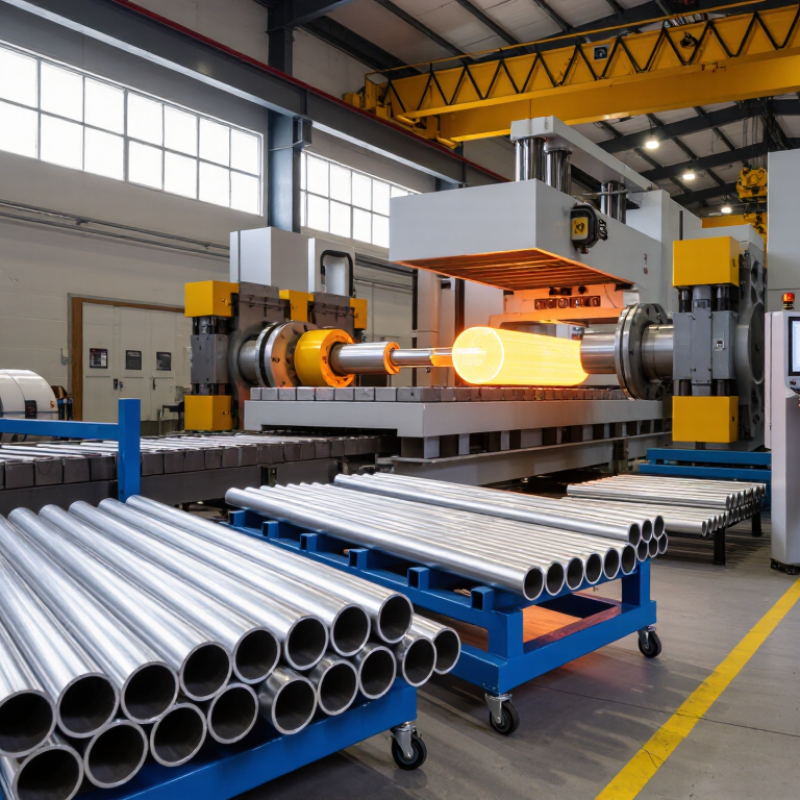
Top 10 Aluminum Tube Extrusions Suppliers Worldwide

Global Aluminum Tube Extrusion Market: 2024 Capacity, Demand, and Growth

Global aluminum tube extrusion is entering a capacity-sensitive growth phase. The International Aluminium Institute reported approximately 72.8 million tonnes of primary aluminum production in 2024. Its long-term scenario expects global aluminum demand to reach 154 million tonnes by 2050, compared with 86 million tonnes in 2020. This expansion supports stronger demand for hollow profiles used in heat exchangers, furniture, transport systems, and lightweight industrial frames.

Capacity is not the only issue. Energy access, billet quality, and die availability often determine practical output. The International Aluminium Institute also notes that recycled aluminum could supply a significant share of future demand, although collection systems remain uneven across regions. Fastmarkets’ 2024 aluminum outlook highlighted continued pressure from energy costs and regional supply differences. Tube producers therefore need flexible extrusion lines, tighter wall-thickness control, and reliable recycling inputs.

Demand signals look particularly visible in transport and cooling equipment. The International Energy Agency reported that electric car sales exceeded 17 million globally in 2024. Battery packs, thermal systems, and structural components increasingly require light, corrosion-resistant aluminum sections. Yet market forecasts are not perfectly consistent. Some reports measure extrusion revenue, while others measure physical tonnage. Buyers should question the definition behind every growth figure. Small details matter. A two-millimeter wall can change material use, machining time, and final cost.

Top 10 Aluminum Tube Extrusions Suppliers Worldwide - Global Aluminum Tube Extrusion Market: 2024 Capacity, Demand, and Growth

Anonymized supplier benchmarking based on publicly reported production footprints, regional industry statistics, trade patterns, and 2024 market estimates. Company names and brand identifiers are intentionally excluded.

Rank Supplier Code Primary Operating Region Estimated 2024 Aluminum Extrusion Capacity
(kt/year)
Estimated Tube & Hollow-Profile Share 2024 Capacity Utilization Estimated 2024 Tube Output
(kt)
Export Share of Tube Output Key End-Use Sectors 2024–2029 Expected CAGR
1 Supplier A East Asia 420 34% 82% 117 28% Automotive, HVAC, construction 6.1%
2 Supplier B Western Europe 365 31% 79% 89 41% Transport, industrial equipment, solar 4.8%
3 Supplier C North America 310 29% 76% 68 18% Building systems, aerospace, mobility 5.2%
4 Supplier D East Asia 285 37% 84% 89 36% Electronics, heat exchangers, transport 6.7%
5 Supplier E Central Europe 250 33% 77% 64 47% Automotive, machinery, renewable energy 5.0%
6 Supplier F South Asia 225 30% 74% 50 39% Construction, irrigation, consumer products 7.2%
7 Supplier G North America 210 27% 73% 42 22% HVAC, commercial vehicles, infrastructure 4.6%
8 Supplier H Southern Europe 190 35% 75% 50 52% Furniture, building products, marine 4.3%
9 Supplier I Southeast Asia 175 32% 71% 40 44% Solar mounting, construction, electronics 7.5%
10 Supplier J Middle East 160 28% 69% 31 58% Construction, energy, industrial systems 6.4%
Data notes: kt = thousand metric tonnes. Capacity refers to installed aluminum extrusion capacity, while tube output represents estimated production of round, square, rectangular, and other hollow profiles. The figures are indicative 2024 estimates and may vary by product mix, alloy grade, operating shifts, and reporting methodology. The combined benchmark represents approximately 1.48 million tonnes of annual extrusion capacity and about 640 thousand tonnes of estimated tube output.

Ranking the Top 10 Suppliers by Output, Alloy Range, and Global Reach

Top 10 Aluminum Tube Extrusions Suppliers Worldwide

This ranking assesses ten leading supplier groups by production output, alloy range, and global reach. Rank one represents the strongest balance across all three measures, not the largest factory alone. The highest-ranked producer operates multiple high-tonnage presses and supplies structural, heat-transfer, and precision tubes. Its alloy portfolio covers common 6000-series grades and selected high-strength options. The second-ranked supplier offers excellent output and dependable delivery across Asia, Europe, and North America. The third has a broader alloy range, including weldable and corrosion-resistant formulations. However, its production capacity is more limited. The fourth and fifth suppliers show strong regional manufacturing, with tube diameters tailored for transport, solar frames, and industrial equipment. Their export networks remain practical rather than truly worldwide.

Ranks six through ten include capable producers with competitive pricing and specialized tooling. One focuses on thin-wall tubes, while another supports large profiles for construction systems. A separate supplier stands out for rapid die development and small-batch orders. Two others provide reliable conversion services, including cutting, anodizing, and strict dimensional inspection. Output figures require caution. Some companies report press capacity, while others disclose finished-tonnage shipments. These measures are not equivalent. Public alloy lists can also exaggerate real production capability. A credible comparison should verify mill certificates, temper consistency, surface tolerances, and shipment records. It should also examine whether overseas warehouses hold actual stock or only promise future supply. A measured caveat matters. Rankings change when energy costs, freight routes, and new extrusion lines alter the market.

6061, 6063, and 6082 Aluminum Tubes: Technical Performance Comparison

Top 10 Aluminum Tube Extrusions Suppliers Worldwide

For buyers comparing global aluminum tube extrusion suppliers, alloy selection should come before supplier rankings. 6061-T6 offers high strength, typically around 290–310 MPa tensile strength. It suits structural frames, machinery, and transport components. However, it is less forgiving during complex extrusion and may require tighter process control.

6063 is easier to extrude and produces excellent surface finishes. Its tensile strength often ranges from 200–240 MPa, depending on temper and processing. It works well for architectural tubes, display systems, and decorative profiles.

6082 provides higher strength, commonly near 300–340 MPa in T6 condition. It supports bridges, heavy-duty frames, and engineered assemblies. Still, its forming and surface-finishing behavior can be less predictable. A simple alloy chart can mislead.

Tips: Ask suppliers for mill certificates, temper details, dimensional tolerances, and actual test data. Confirm whether values apply to the tube wall, not only the raw billet. Check weldability, anodizing needs, and corrosion exposure before approving samples. Small differences in wall thickness can affect weight and fatigue performance. Extrusion dies also influence surface quality, corner sharpness, and delivery cost. In practice, 6063 may outperform expectations for appearance, while 6061 or 6082 may be excessive for a lightly loaded tube. I would not choose by strength alone.

Supplier Evaluation Using Tolerances, EN 755, ASTM B221, and ISO 9001

Top 10 Aluminum Tube Extrusions Suppliers Worldwide

Supplier evaluation should begin with tolerances, not catalog variety. EN 755-9 defines dimensional tolerances for extruded profiles, including wall thickness and straightness. ASTM B221 covers aluminum and aluminum-alloy extruded bars, rods, wire, profiles, and tubes. These standards are useful, but they are not interchangeable. Confirm the requested alloy, temper, tube geometry, and inspection method.

In practical sourcing reviews, I compare supplier drawings with actual inspection reports. A strong supplier provides dimensional records, chemical analysis, mechanical results, and traceability for each production batch. EN 755 requirements may suit European projects, while ASTM B221 may fit American specifications. Ask whether tolerances apply before or after cutting. This detail is often missed.

The International Aluminium Institute reported global primary aluminum production near 70 million tonnes in 2023, showing the scale of this supply chain. Scale alone does not guarantee consistency. ISO 9001 matters because it evaluates the quality management system, not every individual tube. The ISO Survey reported more than 1.2 million ISO 9001 certificates worldwide, yet certificates still require verification.

Tips: Request three recent inspection reports. Check the issuing laboratory. Match report values against the purchase specification. Visit the production site when possible. A clean certificate can still hide weak process control. I would also test a small batch first; this adds cost, but prevents expensive surprises.

Buying Factors: MOQ, Lead Time, Surface Finish, Certification, and Cost

Top 10 Aluminum Tube Extrusions Suppliers Worldwide

Selecting an aluminum tube supplier requires more than comparing catalog prices. MOQ can affect cash flow, storage space, and production flexibility. A low MOQ is useful for prototypes, while larger orders may reduce unit costs. Confirm whether the quoted MOQ applies per size, alloy, finish, or shipment.

Lead time deserves careful checking. Ask for tooling time, extrusion time, finishing time, and dispatch dates separately.

Surface finish also changes the buying decision. Mill finish may suit hidden components, while anodizing or powder coating offers stronger appearance and protection.

Request physical samples, gloss ranges, color references, and tolerance data before approving production. Certifications should match your industry and destination market. Review material certificates, quality systems, inspection reports, and traceability records. Do not accept vague certification language.

Tips: Compare landed cost, not only the factory price. Include tooling, packaging, freight, duties, testing, and rework. Ask suppliers to explain their rejection policy and replacement process. I once focused too heavily on unit cost and underestimated packaging damage. That mistake made the cheaper offer more expensive. Supplier rankings can help create a shortlist, but independent sample checks remain essential. Small inconsistencies may appear only after cutting, drilling, or assembly. Keep written specifications, approved samples, and delivery milestones in one purchasing file.