
Mon - Fri 8:00AM - 5:00PM Central
1150 SE Hamblen Rd, Lee's Summit, MO 64081
China Top 10 Prefab Metal Buildings Suppliers?
China has become a major source of Prefab Metal Buildings for warehouses, workshops, agricultural facilities, and commercial projects. However, choosing a supplier requires more than comparing online prices. Factory experience, steel grades, welding quality, coating systems, engineering support, and export records can strongly affect project results.
This guide examines ten notable Chinese suppliers through practical buying criteria. These include manufacturing capacity, customization options, structural design support, quality-control procedures, packaging, delivery coordination, and after-sales communication. A reliable supplier should provide clear drawings, material specifications, load calculations, and inspection evidence before production begins. Small details matter. Bolt holes should align. Panels should arrive protected from moisture.
The list is intended as a research starting point, not a final endorsement. Supplier capabilities may change, and attractive brochures cannot replace independent verification. Buyers should request recent project references, factory videos, sample documents, and written quotations with complete scope descriptions. Local building codes, permits, foundation conditions, fire requirements, and wind or snow loads must also be reviewed by qualified professionals in the project region.
Some evaluations may remain imperfect because public information is often incomplete or inconsistent. That limitation deserves attention. A lower-cost quotation may exclude insulation, transport, installation, or engineering services. Comparing suppliers on identical specifications creates a fairer result and reduces unexpected expenses. With careful due diligence, this overview can help businesses identify suitable partners for durable, compliant, and efficiently delivered Prefab Metal Buildings.
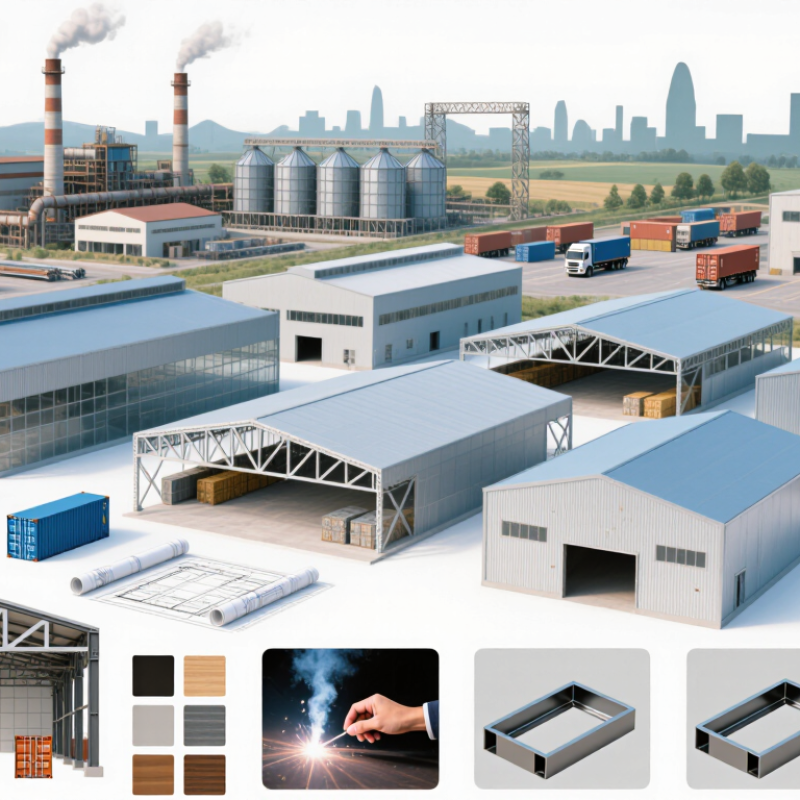
How China’s Top 10 Prefab Metal Building Suppliers Are Evaluated
China Top 10 Prefab Metal Buildings Suppliers?
Evaluating China’s top ten prefab metal building suppliers requires more than comparing quoted prices. Measure the proof. Not the brochure. A credible review should examine factory experience, structural engineering, welding controls, material traceability, and completed projects. The World Steel Association reported that China produced about 1.019 billion tonnes of crude steel in 2023. This indicates substantial industrial capacity, but it does not prove every supplier delivers consistent building quality.
A practical evaluation can assign 25% to verified project experience, 20% to engineering compliance, and 20% to quality assurance. Delivery reliability may receive 15%, after-sales support 10%, and quotation transparency 10%. Auditors should request mill certificates, welding inspection records, coating specifications, and drawings approved by qualified engineers. Site photographs help, but independent inspection records carry greater weight. Factory visits remain useful. They can reveal storage problems, rushed assembly, or weak measurement procedures.
Energy performance also deserves attention. UNEP’s 2024 Global Status Report for Buildings and Construction states that buildings and construction consumed 32% of global energy and produced 34% of global carbon emissions in 2022. Therefore, supplier evaluation should include insulation values, air-tightness details, daylight planning, and corrosion protection. A cheaper structure may create higher operating costs later. No ranking is flawless. Project location, climate, codes, and installation teams can change the result. Suppliers should be judged against documented evidence, not marketing language.
China Top 10 Prefab Metal Buildings Suppliers? - How China’s Top 10 Prefab Metal Building Suppliers Are Evaluated
| No. | Evaluation Dimension | Weight | Verifiable Evidence | Evaluation Method | Relevant Standard or Reference |
|---|---|---|---|---|---|
| 1 | Engineering and Design Capability | 15% | Stamped structural calculations, wind and seismic design data, connection details, and issued-for-construction drawings. | Check whether the supplier can adapt the building to local snow, wind, seismic, fire, and occupancy requirements rather than offering only standard layouts. | GB 50017-2017; applicable local building codes |
| 2 | Steel Material Traceability | 12% | Mill certificates, heat numbers, coating records, incoming inspection reports, and material batch traceability. | Give higher scores to suppliers that can trace structural steel from purchase through fabrication and shipment. | GB/T 1591-2018; GB/T 6725-2017 |
| 3 | Fabrication and Welding Quality | 12% | Welding procedure specifications, welder qualifications, inspection plans, dimensional reports, and non-destructive testing records. | Review the control of welding, cutting, drilling, straightening, assembly, and final dimensional tolerances. | ISO 3834; GB 50205-2020 |
| 4 | Corrosion Protection | 10% | Galvanizing or paint-system specifications, surface-preparation records, dry-film thickness reports, and coating warranty terms. | Compare the selected protection system with the project’s humidity, coastal exposure, chemicals, and maintenance conditions. | ISO 12944; ASTM A123/A123M; ASTM A653/A653M |
| 5 | Building Envelope and Thermal Performance | 10% | Panel core type, declared thermal conductivity, U-value calculations, vapor-control details, and air or water penetration test data. | Evaluate roof and wall assemblies as complete systems, including joints, fasteners, flashings, and openings. | ISO 6946; EN 14509; project energy code |
| 6 | Fire Safety Documentation | 10% | Fire classification reports, tested wall and roof assemblies, fire-resistance ratings, and product compliance declarations. | Reject unsupported fire claims and verify that the tested assembly matches the proposed thickness, joints, insulation, and installation method. | EN 13501-1; ASTM E119; applicable national fire code |
| 7 | Factory Quality Management | 8% | Quality manual, inspection and test plans, calibration records, corrective-action logs, and current management-system certificates. | Verify certificate validity and assess whether documented procedures are consistently used in production. | ISO 9001:2015 |
| 8 | Production Capacity and Delivery Control | 8% | Confirmed production schedule, capacity plan, packaging method, container-loading plan, and shipment documentation. | Score based on documented capacity and schedule reliability, not on unverified claims about annual output. | Purchase contract; Incoterms® 2020; project schedule |
| 9 | Installation and After-Sales Support | 8% | Installation manuals, erection sequence, response-time commitments, spare-part process, and warranty terms. | Assess whether technical support covers foundation interfaces, assembly, troubleshooting, replacement parts, and warranty claims. | Project-specific method statement and warranty agreement |
| 10 | Commercial Transparency and Total Cost | 7% | Itemized quotation, material grades, exclusions, packaging, freight assumptions, taxes, installation scope, and payment conditions. | Compare the total delivered and installed cost instead of comparing only the factory price per square meter. | RFQ documents; Incoterms® 2020; signed contract |
| Total Evaluation Weight | 100% | Use documented evidence, site audits, sample inspections, and project-specific compliance checks before ranking suppliers. | |||