
Mon - Fri 8:00AM - 5:00PM Central
1150 SE Hamblen Rd, Lee's Summit, MO 64081
China Top 10 Stainless Steel Plate Manufacturers?
Choosing among China’s top Stainless Steel Plate Manufacturers requires more than comparing factory size or export volume. Buyers need evidence of consistent chemistry, clean surfaces, reliable tolerances, and responsive technical support. This guide examines ten influential suppliers through practical purchasing criteria, including production capacity, grade availability, certifications, inspection systems, delivery performance, and international service.
As J. R. Davis states in Stainless Steels, “Stainless steels are iron-base alloys containing a minimum of about 11% chromium.” That chromium content supports passive surface protection, but performance also depends on processing, alloy selection, heat treatment, and the intended environment. A plate for a coastal structure faces different demands from one used near acids, high temperatures, or food-processing equipment.
Details matter. A serious Stainless Steel Plate Manufacturer should provide mill test certificates, heat numbers, dimensional records, and traceable inspection results. Buyers should also examine weldability, surface finish, edge condition, packaging, and replacement policies. Small differences can become expensive problems.
Rankings are not permanent.
Market data changes. Some suppliers excel in custom thicknesses, while others offer stronger stock availability or faster export handling. This article therefore treats “top” as a practical comparison, not an absolute verdict. It also recognizes an uncomfortable limitation: published claims may not fully reveal production consistency. Independent testing and sample evaluation remain valuable. The following manufacturers are assessed with that caution, combining documented capabilities with the real questions engineers, fabricators, and purchasing teams ask before placing an order.
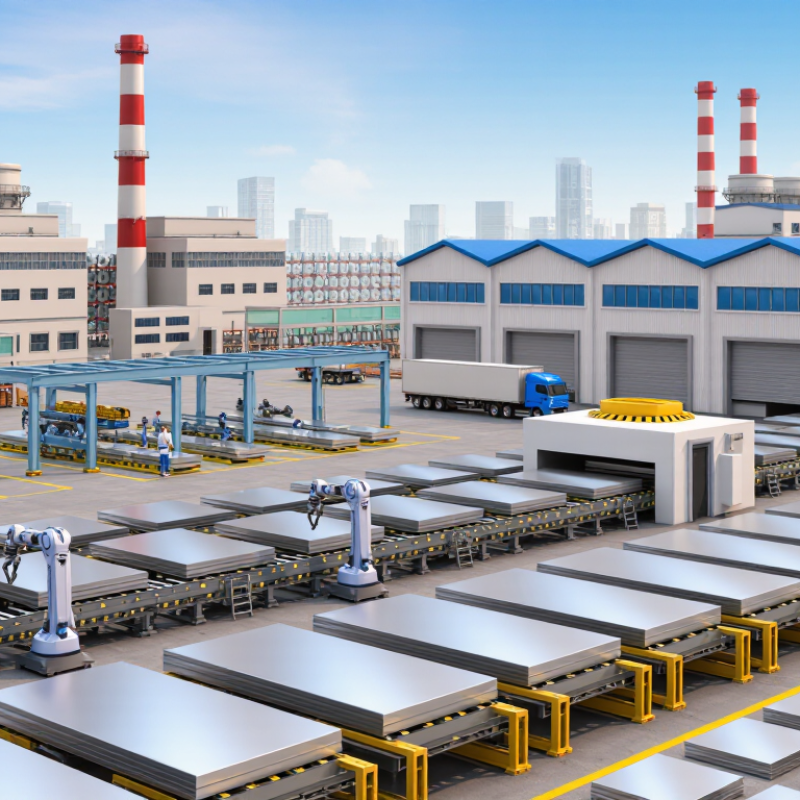
What Defines a Leading Stainless Steel Plate Manufacturer in China
What defines a leading stainless steel plate manufacturer in China? Scale alone is not enough. The International Stainless Steel Forum reported global stainless steel production above 58 million tonnes in 2023. This market size demands stable processes, not impressive brochures. Experienced producers control melting, hot rolling, annealing, pickling, and final inspection. Each stage leaves evidence, such as heat numbers, thickness records, and surface photographs.
Technical discipline matters. A dependable factory should manufacture plates under applicable GB/T, ASTM, or EN requirements. Its laboratory should verify chemical composition, tensile strength, hardness, corrosion resistance, and dimensional tolerance. Testing should follow documented procedures, preferably supported by ISO/IEC 17025 competence. Certificates must match the actual heat and plate, not a repeated template. Small details matter. A 0.3-millimeter thickness variation can disrupt fabrication on a large tank.
Reliability also includes delivery and responsible production. The World Steel Association estimates that steelmaking creates about 7–9% of global carbon dioxide emissions. Leading manufacturers should therefore track energy use, scrap recovery, wastewater, and emissions data. Supply records should remain traceable from coil to shipment. No factory is flawless. Delays, inconsistent finish, or unclear inspection files still occur. The stronger supplier admits weaknesses, investigates causes, and corrects them with measurable actions. That honesty is often more valuable than a perfect sales claim.
China Top 10 Stainless Steel Plate Manufacturers? — What Defines a Leading Stainless Steel Plate Manufacturer in China
Top 10 objective evaluation dimensions for stainless steel plate manufacturing capability
| No. | Evaluation Dimension | Typical Industry Benchmark | What a Leading Manufacturer Should Demonstrate | Reference Standard or Measure |
|---|---|---|---|---|
| 1 | Product Grade Coverage | Common austenitic, ferritic and duplex grades for industrial, architectural and food-processing applications. | Consistent production and documentation for widely used grades such as 304, 304L, 316, 316L and 430, with grade-specific chemical and mechanical test results. | ASTM A240 / EN 10088-2 / JIS G4304 |
| 2 | Thickness and Width Capability | Cold-rolled sheet and plate are commonly supplied in thin, medium and heavy gauges, depending on the mill and finishing line. | Published dimensional ranges, verified thickness tolerances and the ability to supply standard or project-specific widths without compromising flatness. | ASTM A480 / EN 10029 |
| 3 | Surface Finish Range | Common finishes include 2B, BA, No. 1, No. 4, HL and polished surfaces. | Controlled surface roughness, uniform appearance, protective film options and inspection records for decorative or functional finishes. | ASTM A480 finish designations |
| 4 | Chemical Composition Control | Each grade must remain within the applicable limits for chromium, nickel, carbon, molybdenum and other alloying elements. | Heat-level chemical analysis, traceability from raw material to finished plate and material test certificates supplied with shipments. | ASTM A240 chemistry requirements |
| 5 | Mechanical Performance | Yield strength, tensile strength and elongation vary by grade and product condition. | Batch testing confirms the specified mechanical properties after rolling, annealing, pickling or other applicable processing. | ASTM A370 / EN 10088-2 |
| 6 | Dimensional Accuracy and Flatness | Commercial orders require compliance with specified thickness, width, length, squareness and flatness tolerances. | Calibrated measuring equipment, documented inspection plans and quality reports showing compliance with the purchase specification. | ASTM A480 / EN 10029 |
| 7 | Heat Treatment and Metallurgical Control | Solution annealing, pickling and controlled cooling are used when required by grade and product condition. | Stable furnace control, verified processing temperatures and metallographic or hardness checks when required for critical applications. | Grade-specific purchase specification |
| 8 | Testing and Inspection System | Quality systems normally combine chemical, mechanical, dimensional and visual inspections. | Laboratory capability for tensile testing, hardness testing, PMI or chemical analysis, surface inspection and certificate issuance. | ISO 9001 quality-management framework |
| 9 | Traceability and Documentation | Stainless steel orders are commonly controlled by heat number, coil or plate number and batch documentation. | Clear links between the material certificate, production record, inspection report, packing list and shipped plates. | EN 10204 inspection documents |
| 10 | Export Packaging and Delivery Reliability | International shipments require moisture protection, edge protection, secure loading and accurate shipping documentation. | Seaworthy packaging procedures, container-loading controls, delivery planning and support for customized packing or logistics requirements. | Buyer specification and Incoterms® |
Note: The benchmarks above are general industry evaluation criteria rather than rankings or performance claims about specific companies. Actual capability depends on the manufacturer’s equipment, product specification, inspection agreement and applicable standard.