What Are the Top Types of Clear Tempered Glass?
Clear Tempered Glass is chosen for spaces that need daylight, a clean appearance, and added impact resistance. It is not one uniform product. Clear float glass can be tempered at different thicknesses, while low-iron glass offers a brighter, less green edge. Some projects also use patterned or coated options. Each choice changes how light, color, and reflections appear.
Architect Louis Sullivan’s well-known principle, “form ever follows function,” offers a useful lens for comparing these options. It is a design principle, not a glass specification. Details matter. A shower panel, storefront, and glass railing face different conditions, so the right type depends on its location, support, exposure, and required performance. A polished edge may suit a visible partition; a thicker panel may be specified for a larger opening. These details need project-specific review.
This overview will examine the leading types of clear tempered glass, including standard clear, low-iron, patterned, and coated products. It will also distinguish tempered glass from assemblies such as laminated or insulated glass, which combine materials or layers and serve different purposes. Tempered glass is heat-treated, but no glass choice is unbreakable. That point is easy to gloss over. Comparing appearance, thickness, processing, and intended use gives buyers a more reliable starting point than choosing by clarity alone. Even a neat category list has limits: actual performance depends on the finished design and installation.
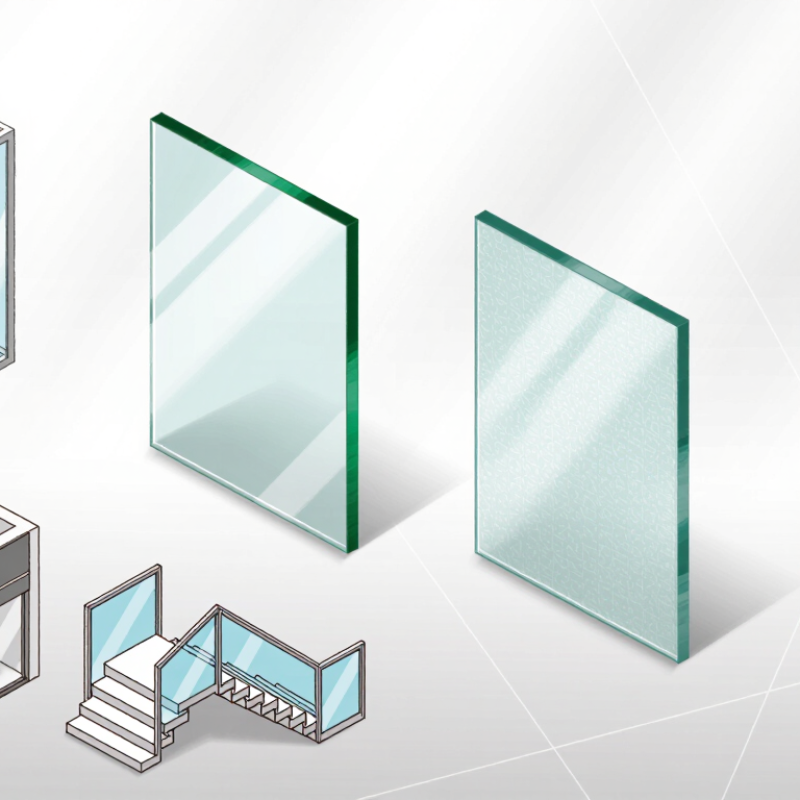
Standard Clear Tempered Glass: Everyday Strength and Clarity
Standard clear tempered glass is a practical choice for shower screens, interior doors, and tabletop covers. It keeps views bright and colors natural, without the green tint sometimes visible along thicker glass edges. During tempering, glass is heated and rapidly cooled, making it more resistant to everyday impacts than comparable annealed glass. Its actual performance still depends on thickness, edge quality, and installation. Strong, but not unbreakable.
When it breaks, tempered glass usually crumbles into many smaller pieces rather than long, sharp shards. That can reduce some injury risks, but broken pieces can still hurt someone. A detail that’s easy to overlook: even a small chip near an edge may affect how well a pane holds up. Clear glass also shows fingerprints, water spots, and dust, especially in bright rooms. That’s useful to remember before choosing it for a frequently touched surface.
Tips: Check the required thickness and measurements with a qualified glass professional before ordering. Ask whether the glass needs holes or cutouts; these must be made before tempering. Clean with a soft cloth and a suitable glass cleaner to limit scratches and streaks. If the fit looks uneven, pause and have it checked rather than forcing the pane into place.
What Are the Top Types of Clear Tempered Glass? - Standard Clear Tempered Glass: Everyday Strength and Clarity
| Typical Thickness | Approx. Weight per Square Metre | Indicative Visible Light Transmission | Everyday Characteristics | Common Applications |
| 4 mm | About 10 kg | About 90% | Lightweight option with clear appearance; suitable where the glass size and design loads allow. | Small interior panels, cabinet doors, and selected furniture components. |
| 6 mm | About 15 kg | About 89% | A versatile everyday thickness that balances visibility, weight, and strength. | Shower screens, doors, partitions, and general interior glazing. |
| 8 mm | About 20 kg | About 88% | Heavier and more rigid than thinner options; suitability depends on panel dimensions and support. | Larger shower panels, interior partitions, and glass furniture. |
| 10 mm | About 25 kg | About 86% | Provides a substantial feel for larger panels while retaining the appearance of clear glass. | Frameless doors, robust partitions, and larger architectural panels. |
| 12 mm | About 30 kg | About 84% | A thick, heavy option often selected for demanding panel sizes or design requirements. | Heavy frameless doors, large interior screens, and specialized architectural glazing. |
Notes: Weight estimates use a typical soda-lime glass density of approximately 2,500 kg/m³. Light-transmission figures are indicative values for clear glass; actual results vary with thickness, glass composition, coatings, and manufacturer. Tempering improves strength compared with annealed glass of the same thickness, but it does not make glass unbreakable. Final thickness and safety-glazing requirements should be determined for the specific application and applicable local codes.
Low-Iron Tempered Glass: Enhanced Light Transmission
Low-iron tempered glass starts with a clearer base glass. It contains less iron oxide, which reduces the green tint visible along exposed edges. In a bright lobby, shopfront, or glass railing, that can make white walls and pale fabrics look more neutral. The change is subtle in a small sample. It becomes easier to notice across a large pane.
Published industry technical data sheets for 6 mm glass commonly report visible light transmittance near 91% for low-iron glass, compared with roughly 89% for standard clear glass. These figures are indicative, not universal; thickness, coatings, and test methods affect results. Tempering adds strength, but the low-iron composition is what improves clarity. That matters. For project comparisons, check the actual visible-light-transmittance value, not just a product’s “clear” label.
The practical trade-off is often cost, alongside the desired appearance. Low-iron glass can be useful where color fidelity matters, such as display cases or interior partitions beside daylight. Still, higher light transmission does not automatically mean a better design. Glare may increase near a sunny window, and reflections remain. I would compare full-size samples in the actual room; small samples can make the tint difference seem larger than it feels in use.
Source: published 6 mm industry technical data sheets; values vary by specification.
Heat-Soak-Tested Tempered Glass: Lower Risk of Spontaneous Breakage
Heat-soak-tested tempered glass is tempered glass that receives an additional, controlled heating cycle after tempering. The process can trigger breakage in some panels containing nickel sulfide inclusions, which may otherwise fail later without an obvious impact. This lowers the risk of spontaneous breakage, but it does not remove it.
For a clear glass door or façade, the distinction matters: a sudden panel failure can mean costly replacement and disruption. Heat soaking is not a visual upgrade; the finished pane may look identical to untreated tempered glass. Ask for traceable test documentation and confirm that the specified glass suits the panel size, support system, and use. I would not treat a certificate as a promise. Installation damage, especially small chips along an edge, can still contribute to failure.
Tips: Check the glass specification before ordering, and inspect edges during installation. Keep records with the project file. If a panel breaks, avoid handling fragments and have the site assessed by a qualified glazier.
Laminated Tempered Glass: Added Safety After Breakage
Laminated tempered glass combines heat-strengthened panes with a bonded interlayer, usually polymer. If the glass breaks, the interlayer can hold many fragments together instead of letting them fall freely. The National Glass Association’s technical guidance describes this fragment-retention benefit, but performance depends on the full assembly. Frame depth, edge support, and compatible sealants matter. A cracked panel can still be hazardous. Not invincible.
Impact resistance is measured under defined test conditions. The U.S. Consumer Product Safety Commission’s 16 CFR Part 1201 sets impact-test levels of 150 foot-pounds for Category I and 400 foot-pounds for Category II glazing. These figures are test thresholds, not promises that a panel will withstand every real-world impact. Ask for test documentation for the exact glass build-up, including pane thickness and interlayer type. Also check whether the intended frame can retain the panel after breakage. One detail is easy to miss: laminated glass may remain in place while cracked, so the damaged area can still need prompt isolation and professional replacement.
What Are the Top Types of Clear Tempered Glass?
Laminated tempered glass adds an interlayer between glass panes for added safety after breakage.
Counts show basic construction, not performance ratings: monolithic tempered glass has one pane; laminated tempered glass has at least two panes bonded by an interlayer. The interlayer helps hold broken fragments together.
Choosing the Right Type for Each Application
Clear tempered glass is not one-size-fits-all. The right choice depends on where it will sit, how it will be supported, and what people need to see through it. For shower enclosures and interior doors, standard clear glass usually gives a clean view at a practical cost. Its edges may show a faint green tint, especially on thicker panels.
Low-iron clear tempered glass reduces that green cast, so it suits display cases, bright kitchens, and spaces where accurate color matters. It often costs more, and the improvement is most noticeable at exposed edges. A small sample beside a white tile can help reveal the difference. Small detail.
Thickness also matters, but it should match the panel size, hardware, and installation conditions—not a guess based on appearance. For tabletops or partitions, confirm that edges are polished and mounting points are designed before tempering; finished tempered glass cannot be cut or drilled afterward. In areas where broken pieces must stay in place, a laminated-tempered build may be appropriate, subject to project requirements. Ask a qualified fabricator to check dimensions and applicable safety standards. The overlooked part? Support and installation can matter as much as the glass itself.
