China Best Polyester Polymer Concrete Manufacturers?
Choosing among China’s polyester polymer concrete manufacturers requires more than comparing factory prices. The material may look similar in a brochure, yet resin formulation, aggregate grading, curing control, and workmanship can produce different results. A panel intended for a drainage channel faces different demands from a machine base or a chemical-resistant floor. Details matter.
Polymer-concrete researcher Donald W. Fowler has published extensively on polymer concrete. A useful principle consistent with his work is: “Specify by service conditions, not by resin name alone.” Treat this as a practical summary, not a verified verbatim quotation. For buyers, that means asking manufacturers for product data, test methods, batch traceability, and examples of comparable installations. Check how they control resin content and curing, and ask how they manage dimensional tolerances, surface finish, and defects. A polished sample is helpful. It is not enough.
This guide introduces ways to assess China-based suppliers, compare product capabilities, and prepare questions before requesting quotations. It also considers where polyester polymer concrete may fit—and where another material could be more suitable. Be cautious with broad claims such as “best” or “chemical-proof.” Performance depends on the chemical, temperature, exposure time, and installation conditions. Even a careful shortlist cannot replace project-specific testing. That limitation deserves attention. A supplier’s responsiveness, documentation, and willingness to discuss constraints can reveal as much as its catalogue.
Polyester Polymer Concrete: Resin Binders, Aggregates, and Typical 10–15% Binder Content
China Best Polyester Polymer Concrete Manufacturers?
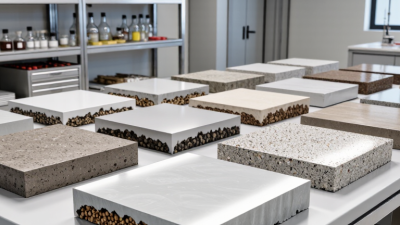
Polyester polymer concrete combines a polyester resin binder with graded mineral aggregates. The resin binds the particles and hardens without relying on cement hydration. Aggregate size, cleanliness, and moisture can all affect placement and final performance. A common formulation may contain about 10–15% binder by weight, with the balance made up largely of aggregates. This range is a starting point, not a fixed recipe. Small details matter.
Manufacturers typically adjust the resin content to suit the aggregate grading, intended use, and required flow. Too little binder can leave dry, poorly coated particles. Too much may raise cost, increase shrinkage risk, or make the mix harder to control. Trial batches help reveal whether the mix fills corners, releases air, and cures evenly. A glossy surface alone does not prove the internal structure is sound. That part is easy to overlook.
Tips: Keep aggregates dry and consistently graded before mixing. Measure resin and hardener carefully, and follow the supplier’s stated mixing and curing conditions. Record batch temperature, working time, and any visible segregation. If a 10–15% binder level performs poorly, review the aggregate blend and test method before simply adding more resin. Real production conditions can differ from a small laboratory sample, so verify results at practical scale.
Key Performance Benchmarks: Typical Compressive Strength of 70–140 MPa
For buyers comparing polyester polymer concrete manufacturers in China, compressive strength is a useful starting point. Typical reported values range from 70 to 140 MPa, but the number depends on resin content, aggregate grading, curing conditions, and the test method. A 100 MPa result from one supplier may not be directly comparable with another’s.
Ask for recent test reports that identify specimen size, curing age, and testing procedure. Then check whether production batches can consistently meet the stated value. Look for clear records of resin and aggregate proportions, plus quality checks on incoming materials. Small details matter. A well-graded mix can reduce voids; poor curing control may leave strength uneven across a panel.
Compressive strength alone does not establish suitability. For a drainage channel, equipment base, or chemical-resistant floor, review flexural strength, water absorption, chemical exposure data, and dimensional tolerances too. Request samples made with the intended formulation, not just a polished catalogue specimen. The 70–140 MPa range is a benchmark, not a promise. It is easy to focus on the highest figure; I would still want repeatable results and test conditions stated plainly.
ASTM C579 and C580: Measuring Compressive and Flexural Strength
China Best Polyester Polymer Concrete Manufacturers?
ASTM C579 and C580: Measuring Compressive and Flexural Strength
ASTM C579 measures compressive strength in chemical-resistant mortars, grouts, and monolithic surfacings. ASTM C580 measures flexural strength for these material categories. For polyester polymer concrete, confirm that the product and specimen type fit the applicable method before comparing results. Small details matter: specimen dimensions, curing conditions, and loading rate can affect the reported values.
Compressive strength indicates how well a material withstands a direct load. Flexural strength shows its resistance to bending, which can matter around edges, joints, and unsupported areas. Neither result alone predicts service life. A high laboratory value may not reflect a damp substrate, uneven installation, or temperature changes. That distinction is easy to overlook. Ask for test reports that identify the method, specimen preparation, and test conditions, rather than relying on a number without context.
Tips: Compare like with like. Check whether samples were cured under similar conditions, and review both C579 and C580 results. If the report leaves out preparation details, ask for clarification before making a decision. One test rarely tells the whole story.
China Best Polyester Polymer Concrete Manufacturers? — ASTM C579 and C580: Measuring Compressive and Flexural Strength
ASTM C579 measures compressive strength, while ASTM C580 measures flexural strength and modulus of elasticity. These standards describe test methods; they do not set universal strength limits for polyester polymer concrete.
Unit-conversion reference only: 1 MPa ≈ 145.038 psi. Values are not test results or performance claims for any product. Compare products using laboratory results obtained with the applicable ASTM test method.
Chinese Manufacturing Processes, Quality Controls, and Industrial Applications
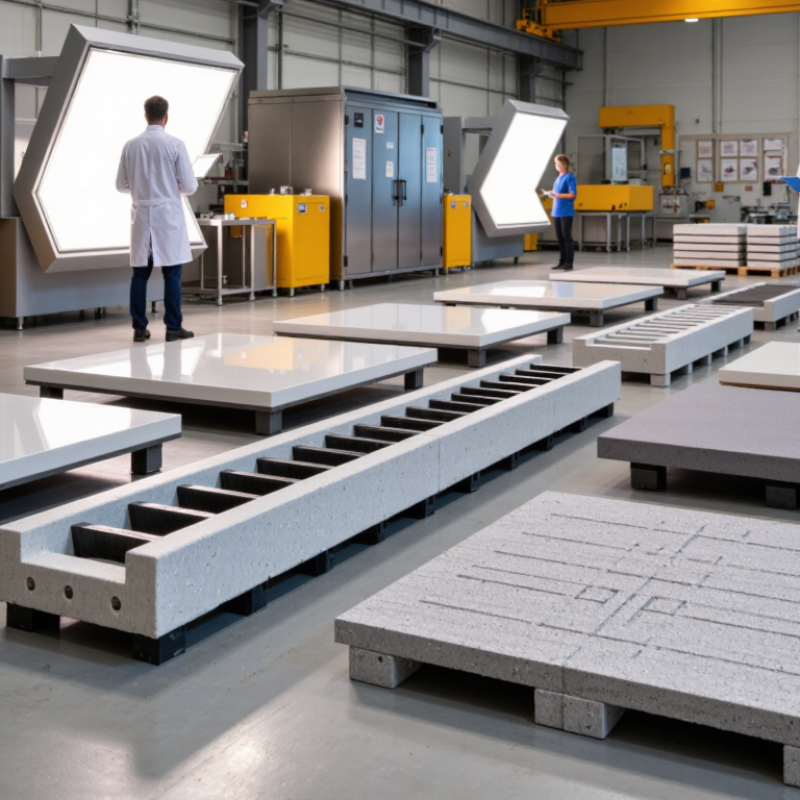
In China, polyester polymer concrete production starts with selected resin, graded mineral aggregates, and a defined mix design. Operators check aggregate moisture and particle size before batching, since either can change flow and final strength. Resin and catalyst are dosed carefully, then mixed until the aggregate is evenly coated. Temperature matters. Too much heat can shorten working time; cold conditions may slow curing. Reliable plants record batch numbers, mixing times, and curing conditions instead of relying on memory. Small differences still happen. Even a tidy process needs adjustment when raw materials shift.
Quality control should include incoming-material checks, visual inspection, and test specimens from production batches. Depending on the product, teams may measure compressive strength, water absorption, dimensional consistency, or chemical resistance. Results need clear records and repeatable methods; a single strong sample proves little. These controls support use in drainage channels, industrial floors, equipment bases, and corrosion-resistant containment areas. Designers should match resin chemistry and aggregate selection to actual temperatures, loads, and exposure. Factory claims cannot replace project-specific testing. Some choices remain imperfect: faster production can conflict with longer inspection and curing windows.
How to Compare China-Based Manufacturers: Testing, Certifications, and Customization
When comparing China-based polyester polymer concrete manufacturers, ask for test reports tied to the exact formulation you plan to buy. ASTM C579 measures compressive strength, while ASTM C580 evaluates flexural strength and modulus. Request specimen dimensions, curing conditions, test dates, and laboratory details—not just a single strength figure. A result from a different resin or aggregate blend may not predict your project’s performance.
Certifications need careful reading. The ISO Survey 2022 recorded 1,265,216 valid ISO 9001 certificates worldwide, but this quality-management certification does not prove a product meets your design requirements. Check whether the certificate covers the actual production site. Then review batch records, inspection procedures, and traceability from resin and aggregate to finished parts. A neat certificate can still leave gaps.
Customization should be tested, not promised. Share the service temperature, chemical exposure, loading, dimensions, and installation method, then request a sample made with the proposed mix. Compare its color, edge finish, and dimensional tolerance with your drawings. Ask how changes in aggregate grading or resin content affect test results. I would still verify one point: a sample may not represent full-scale production. Keep approval samples and agreed acceptance limits in writing.